
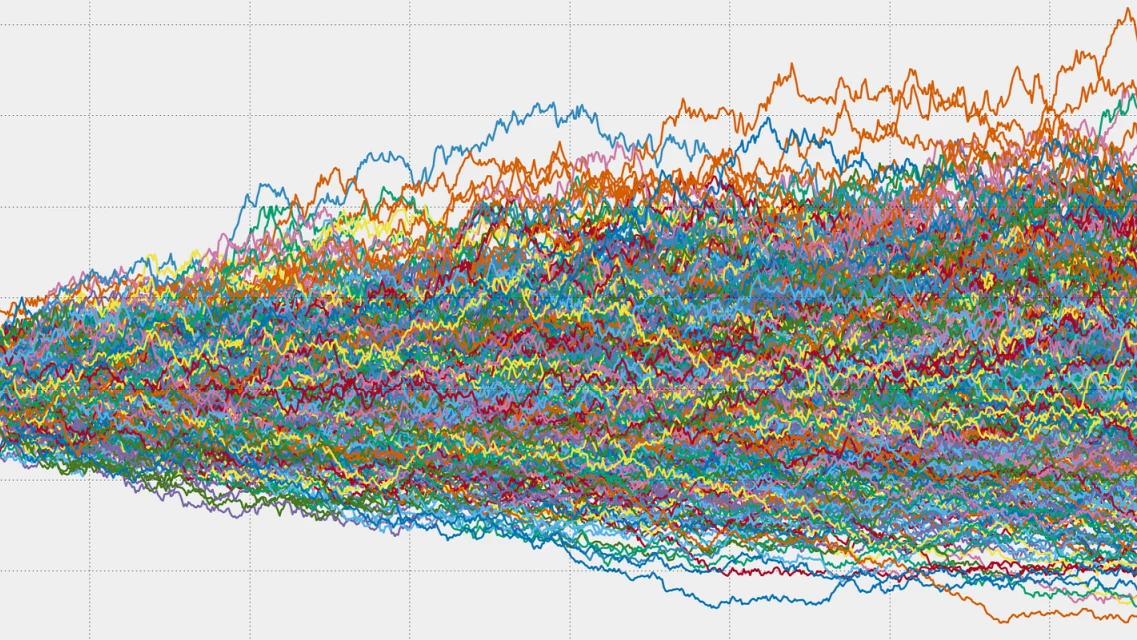
In today’s sustainability driven landscape, Life Cycle Assessment (LCA) is the gold standard for evaluating the environmental impacts. Yet, no dataset is ever perfect. Whether you're dealing with emission factors, energy consumption, or material flows, uncertainty is an inherent part of LCA.
This is where Monte Carlo Analysis (MCA) becomes essential. By simulating hundreds or thousands of possible outcomes, MCA quantifies how uncertain input data influence your final LCA results making your conclusions more reliable, transparent, and defensible.
What Is Monte Carlo Analysis in LCA?
Monte Carlo Analysis is a probabilistic simulation method that quantifies how variability and uncertainty in inputs affect assessment results. Within LCA, MCA recalculates environmental impacts multiple times using randomly sampled values from specified probability distributions.
Rather than delivering a single deterministic result, MCA offers a range of possible outcomes, allowing practitioners to understand
- The most probable result
- The range of variation across simulations
- The likelihood of different scenarios occurring
This approach aligns with ISO 14044, which identifies uncertainty analysis as a key component of LCA especially for comparative assertions, Environmental Product Declarations (EPDs), and public reporting.
Why Use Monte Carlo Analysis in LCA?
- To Reflect Real World Variability - Data in LCA often comes from diverse sources and reflects fluctuating real-world conditions. MCA captures that variability, offering a more realistic picture.
- To Quantify Data Uncertainty - Whether using secondary databases or estimated figures, LCA often involves assumptions. MCA allows practitioners to understand how much confidence they can place in their results.
- To Enable Better Decision-Making - When comparing products, materials, or design choices, MCA answers a key question, Is the observed difference statistically meaningful or just noise?
- To Align with ISO Standards - Standards like ISO 14044 and ISO 14067 emphasize the importance of uncertainty analysis. In comparative and public facing LCAs, MCA is not only best practice it’s often expected.
Key Benefits of Monte Carlo Analysis in LCA
- Statistical Confidence - MCA yields confidence intervals for impact categories such as climate change or water use, lending scientific rigor to your findings.
- Visual Clarity - Probability distribution graphs help stakeholders visualize not only average values but also the uncertainty ranges around them.
- Comparative Certainty - When comparing alternatives, MCA can statistically validate whether observed differences are significant or within uncertainty bounds.
- Improved Credibility - Addressing uncertainty openly enhances transparency and trustworthiness, especially in third-party reviews and public disclosures.
- Strategic Data Focus - MCA highlights which parameters contribute most to output variability, guiding data quality improvements in future assessments.
Monte Carlo Analysis brings quantitative depth and strategic insight to traditional Life Cycle Assessment. Rather than offering a single answer, it empowers stakeholders with a clear understanding of result reliability is a crucial asset in today’s high stakes sustainability environment.
#Sustainability #LifeCycleAssessment #MonteCarloAnalysis #LCA #MCA
Originally published by Dulshan Godakumbura on LinkedIn.



 United Arab Emirates
 Sri Lanka
While larger corporations often have complex data security systems in place, small businesses can also fall victim to a cyber attack if they do not take steps to protect themselves